
 English
Journey from Volunteering to Research A Bilingual Classification Guide and Case-Based Pathways for Para Sport Participation
- Authors:Suo Park, Suan Park(St. Stephen Episcopal School, The University of Texas at Austin)
- Publication Date:February 27, 2026
- Type:IJCSY Vol.1 No.1
- DOI:https://doi.org/10.23410/IJCSY.2026.1.1.01
- Volume/Issue:1/(1)
Abstract
Background: Para sport can advance rehabilitation, health, confidence, and social participation, yet newcomers often face information gaps and difficulty navigating classification and first steps. This project developed Power in Motion, a bilingual (English/Korean) plain-language guide that explains classification, links to official rules, and organizes impairment-based entry pathways. We paired the guide with case-mapped recommendations to test practical use. Methods: We used a practical qualitative workflow integrating (1) participant observation at classification events, training sites, and hospitals in Korea (2018–2025); (2) development of a bilingual guide featuring classification basics, an impairment–sport mapping table, concise sport pages with current rule links and minimum impairment criteria, and curated federation/hospital contacts; and (3) individualized pathway design for two adults. Field notes informed thematic analysis and guide structure. Case work was retrospective, de-identified, and exempt from full institutional review. Results: Observations highlighted three barrier domains: information/language(uncertainty about eligibility and where to begin), structural/administrative (classifier shortages, event-only scheduling, centralization), and psychological (early discouragement and fear of a “wrong class”). The guide enabled rapid scanning of eligible sports and direct access to authoritative
Keywords:
classification, eligible impairment, para sport, participation barriers, rehabilitation, sport classfigures
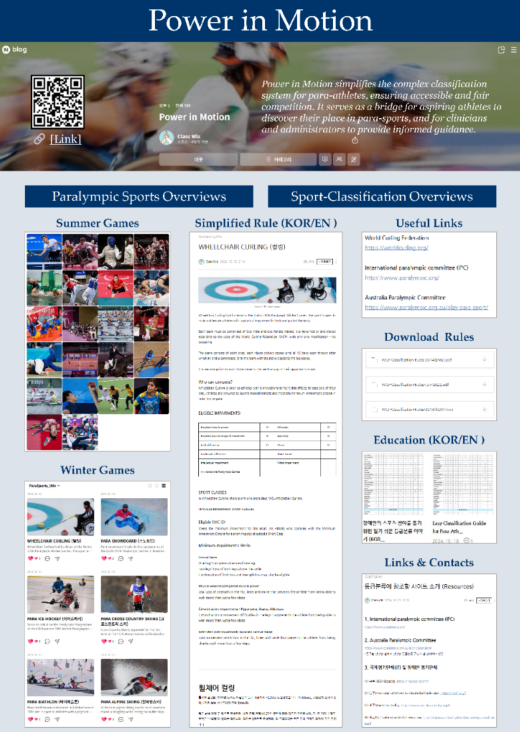
Fig. 0 Poster overview of Power in Motion, a bilingual (EN/KR) guide to Paralympic classification, showing site structure and key resources. Source: Power in Motion blog, Park Suo & Park Suan
References
- Park, J. W., Park, S., Park, S., & Han, S. H. (2025). Impairment-based guidance for para-sports selection: Insights from two case studies. Soonchunhyang Medical Science, 31(1), 14–18.
- Blauwet, C., & Willick, S. E. (2012). The Paralympic Movement: Using sports to promote health, disability rights, and social integration for athletes with disabilities. PM&R, 4(11), 851–856.
- Han, S. H., Lee, W. J., Park, J. W., et al. (2023). Basic research for the standardization of the sports classification system for athletes with disabilities (Final research report). Seoul: Korean Paralympic Committee. (In Korean)
- Jaarsma, E. A., Dijkstra, P. U., Geertzen, J. H. B., & Dekker, R. (2014). Barriers to and facilitators of sports participation for people with physical disabilities: A systematic review. Scandinavian Journal of Medicine & Science in Sports, 24(6), 871–881. https://doi.org/10.1111/sms.12218
- International Paralympic Committee. (2025). Paralympic classification. https://www.paralympic.org/classification
- Tweedy, S. M., & Vanlandewijck, Y. C. (2011). International Paralympic Committee position stand: Background and scientific principles of classification in Paralympic sport. British Journal of Sports Medicine, 45(4), 259–269. https://doi.org/10.1136/bjsm.2009.065060
- Wileman, T. M., McKay, M. J., Hackett, D. A., et al. (2025). Guiding evidence-based classification in para sporting populations: A systematic review of impairment measures and activity limitations. Sports Medicine, 55, 341–391. https://doi.org/10.1007/s40279-024-02132-y
- Park, S., & Park, S. (2024). Power in Motion: Classification [Blog]. Naver Blog. Retrieved May 14, 2025, from https://blog.naver.com/qkrtndks8_
- ActiveSG Circle. (2024). Para archery and rehabilitation. https://www.activesgcircle.gov.sg/learn/archery/para-archery-and-rehabilitation
- Quantum Rehab. (2025). A beginner’s guide to wheelchair fencing. https://www.quantumrehab.com/resources/consumer-article-a-beginners-guide-to-wheelchair-fencing.asp
- Suarez-Iglesias, D., Ayan Perez, C., Mendoza-Laiz, N., Villa-Vicente, J. G., & others. (2020). Boccia as a rehabilitation intervention for adults with severe mobility limitations due to neuromuscular and other neurological disorders: Feasibility and effects on upper limb impairments. Frontiers in Psychology, 11, 581.
- Children’s Hemiplegia and Stroke Association. (2025). Sports. https://chasa.org/disability-sports/
- Camuncoli, F., Polisciano, R., Este, A., Cernivani, G., Simoni, G., Piccinini, L., et al. (2023). Feasibility of a kinematics-based protocol for monitoring a patient with hemiplegia while performing indoor rowing. Gait & Posture, 106(Suppl 1), S34–S35.